This article contains affiliate links. If you book through them we may earn a small commission at no extra cost to you — it helps keep Authentic Japan free.
Kyoto's problem in autumn is not finding maples — it is choosing between forty famous places that all look the same in the guidebook. They are not the same. Some are evening-only, some are daytime-only, some charge ¥1,500 and some are free, and in 2026 the peak arrives late, which changes which ones are worth visiting on which dates. This guide picks the handful worth planning around and tells you what each is best for. Every date and price below was checked against Kyoto City's official tourism site or the temple's own page on 25 September 2026; schedules can still change, so confirm the day before you go.
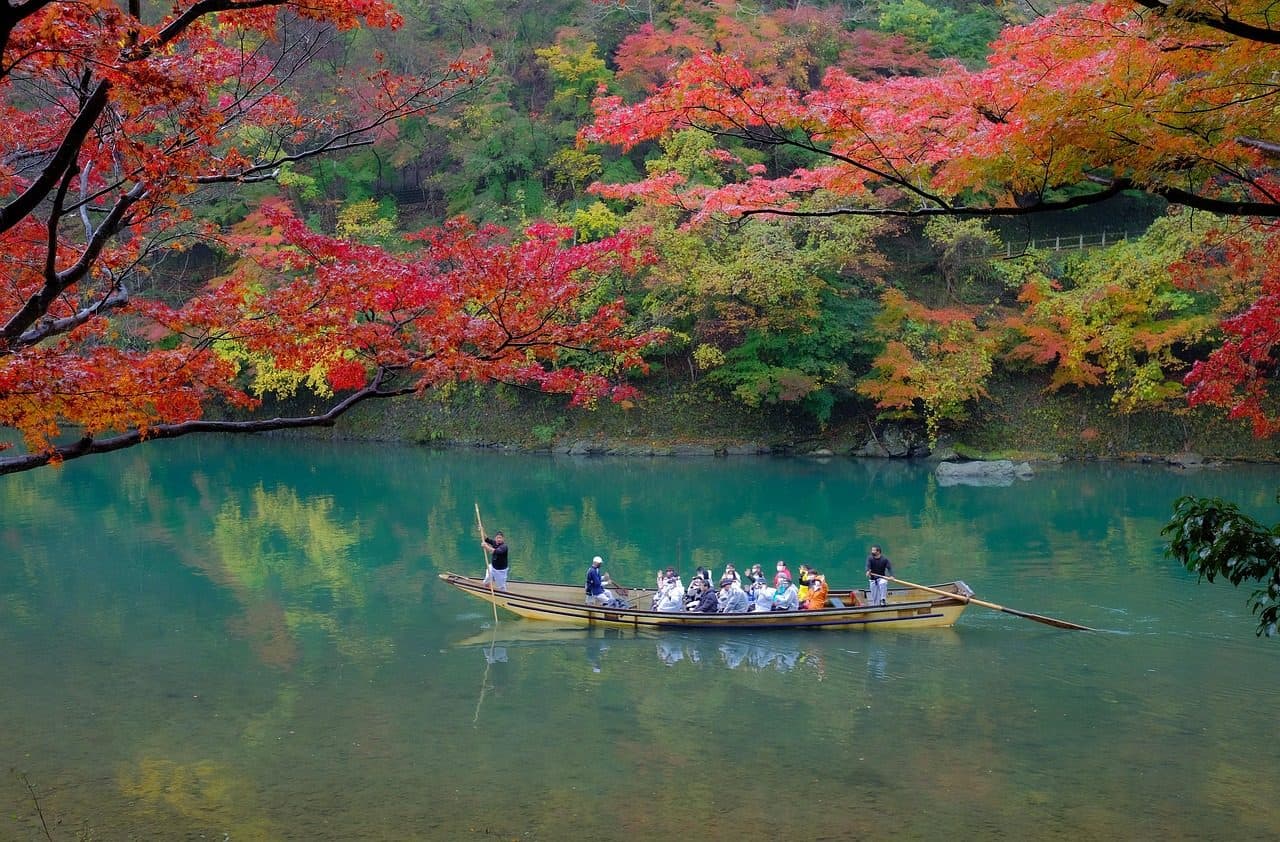
The context for timing: Weathernews forecasts the hillsides at Arashiyama to peak around November 24, while Japan Meteorological Corporation puts the reference maples in central Kyoto around December 11. The 2026 calendar also has a three-day weekend from Saturday November 21 to Monday November 23 (Labor Thanksgiving Day) right as the color builds. The regional foliage guide covers the whole country; this page is only about choosing in Kyoto.
Pick by what you want, not by fame
| Spot | Best if you want… | 2026 dates | Adult entry |
|---|---|---|---|
| Kiyomizu-dera (evening) | The postcard view with city lights and a searchlight | Nov 21–30, 17:30–21:00 | ¥500 |
| Eikando | The most maples in one garden, by day or night | Day Nov 11–Dec 6; evening Nov 20–Dec 6 | ¥1,500 day / ¥1,000 evening |
| Tofuku-ji | A bridge above a valley of maples, by day | Nov 14–Dec 6, 8:30–16:00 | ¥1,000 (bridge and Kaisando) |
| Kitano Tenmangu Momiji-en | Autumn at a shrine, with a river and a bridge | Oct 31–Dec 6; evenings from Nov 13 | ¥1,500 |
| Kifune Shrine | A free evening walk in the mountains | Nov 7–24, sunset–20:30 | Free |
| Kodaiji | The longest-running evening light-up in Higashiyama | Oct 23–Dec 13, 17:00–21:30 | ¥800 |
| Shorenin | An evening garden in eastern Kyoto | Nov 7–Dec 6, 18:00–22:00 | ¥1,000 |
Fees are paid at the gate. Two things matter more than the price: several temples run separate day and evening sessions that do not carry over (Eikando and Shorenin both do), and the most popular ones fill on weekends and on November 21–23. There is no official crowd data, so plan around the calendar rather than a promise of quiet.
Temples: the three for maples
Eikando — the maples are the point
Eikando (Zenrin-ji) has been called "Momiji no Eikando" — Eikando of the maples — for centuries, and roughly 3,000 maples fill a garden built around a pond. In 2026 the daytime season, run with its autumn temple-treasure exhibition, is November 11 to December 6, 9:00–16:00 (¥1,500 general, ¥1,000 university students, ¥800 junior and senior high). The evening light-up is November 20 to December 6, 17:30–20:30 last entry at ¥1,000. It is a changeover system, so a daytime ticket does not let you stay for the evening. If you are choosing one session, the evening is the cheaper ¥1,000 one.
Tofuku-ji — go by day, for the bridge
Tofuku-ji's Tsutenkyo is a covered bridge above a maple-filled valley, and it is a daytime experience: during the autumn period (November 14 to December 6) the bridge is open 8:30–16:00 for ¥1,000, which includes the Kaisando hall. The main hall garden costs ¥600 separately. The temple notes that photography on the bridges may be restricted when it is busy, and there is no hand-written goshuin during the season. It is a short walk from Tofukuji Station on the JR Nara and Keihan lines, which makes it easy to pair with a morning start.
Kiyomizu-dera — the evening is the point
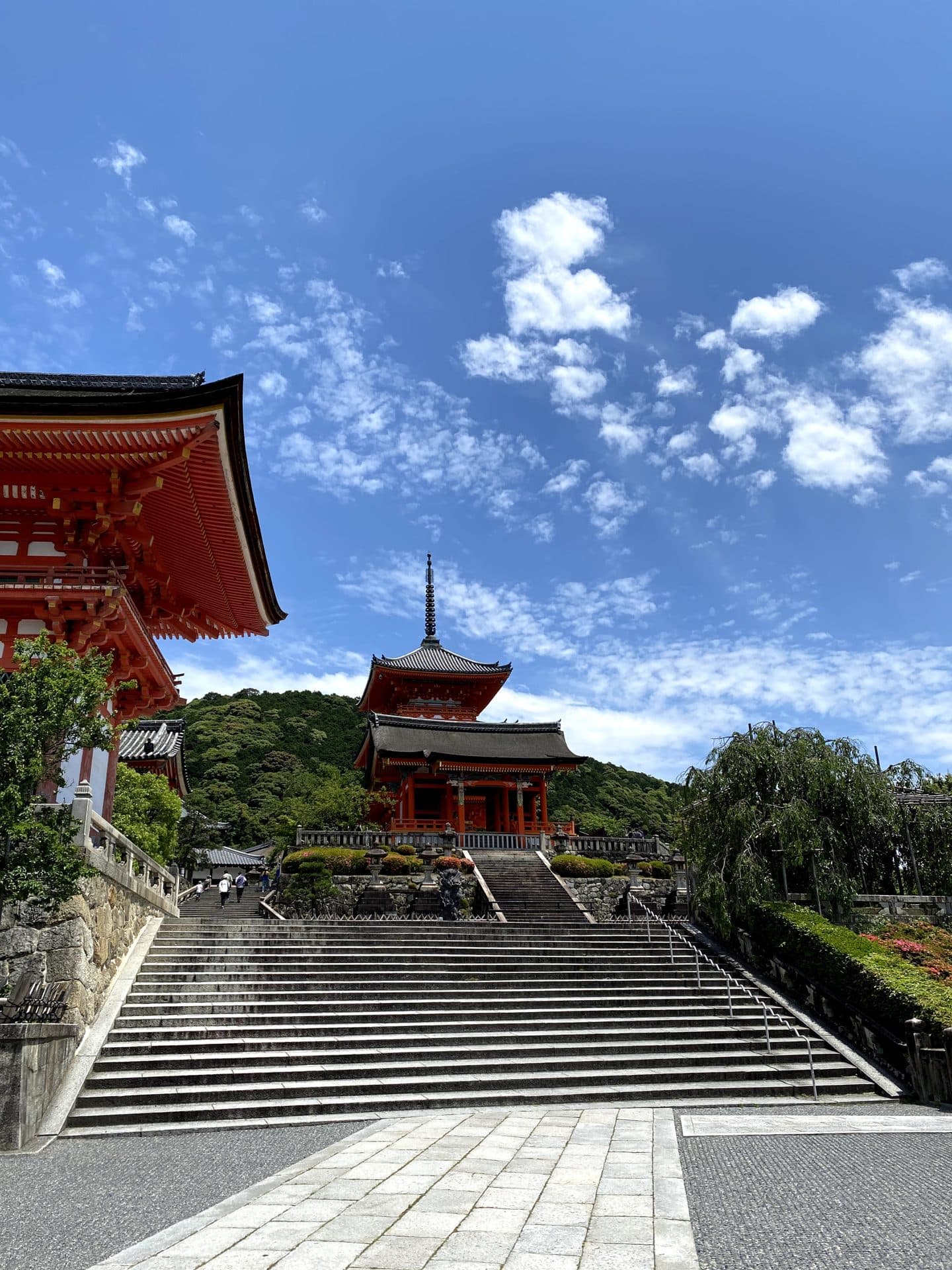
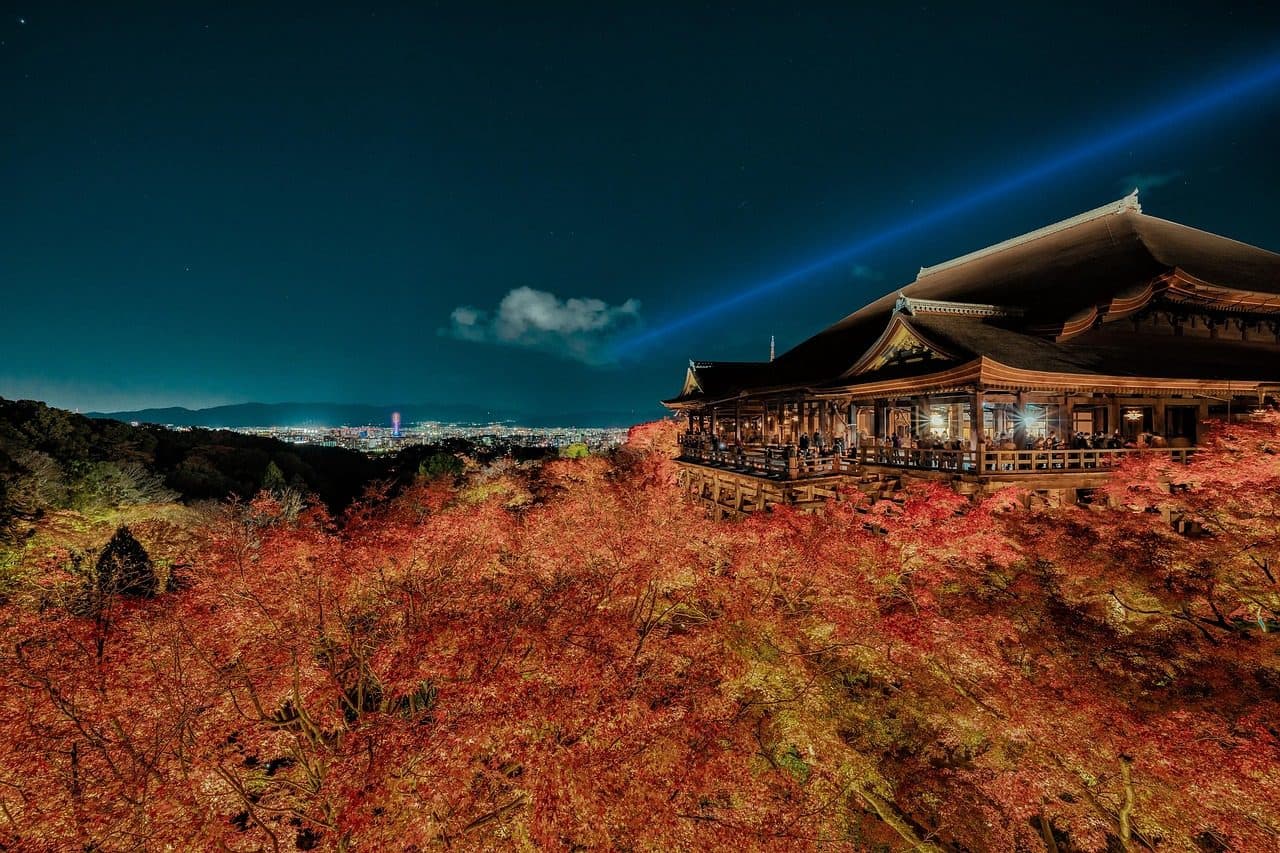
Kiyomizu-dera's autumn evening opening runs November 21 to 30, 17:30–21:00, and costs ¥500 for adults (¥200 for elementary and junior high). Kyoto City's listing describes a blue searchlight, the "Kannon Jihi-ko", sweeping over the city and around a thousand maples lit below the main hall's stage. Note that it opens on the first night of the three-day weekend. The weekday nights of November 24–27 and Monday the 30th are the calmer choice inside that window.
Shrines with autumn color
Most of Kyoto's famous foliage is temples, but the shrines below are worth building a day around — one costs the same as a temple, one is free, and one is a forest walk.
Kitano Tenmangu — the Momiji-en
Behind Kitano Tenmangu, the Momiji-en follows the remains of a historic earthwork, the Odoi, with the Kamiya River and a red-lacquered footbridge as its centrepiece. The 2026 opening is October 31 to December 6, 9:00–16:00 (last entry 15:40), with an evening light-up from November 13, sunset to 20:00 (last entry 19:40). Entry is ¥1,500 for adults and ¥700 for elementary school children. The shrine names a maple over 400 years old among its highlights. Because it opens nearly a month before the peak, it is the most flexible option on this list for a mid-November trip.
Kifune Shrine — free, in the mountains
Kifune Shrine sits in a valley north of the city, reached by the Eizan Railway to Kibune-guchi and then a short bus ride or a walk up the river. Its evening illumination runs November 7 to 24, sunset to 20:30, and is free. The altitude means the color arrives earlier than in the city, so it suits an early or middle-November trip better than a late one, and the window closes on the day Arashiyama is forecast to peak.
Shimogamo Shrine — the forest that turns late
Shimogamo Shrine's Tadasu no Mori is an old forest of about 12 hectares running south from the main shrine, and Kyoto City's foliage listing gives its typical peak as early December onward. There is no ticketed event, and the shrine's gates are open 6:30–17:00, so it is an early-morning or fallback choice rather than an evening one — a sensible option if the famous hillsides are past their best by the time you arrive. It is about ten minutes' walk from Demachiyanagi Station on the Keihan line.
Higashiyama evenings: Kodaiji and Shorenin
Kodaiji runs the longest programme of any temple here — October 23 to December 13, lighting from 17:00 with last entry at 21:30 — at ¥800 for adults. Start dates that early mean the opening is well ahead of the color, so aim for late November or December. Shorenin, which runs November 7 to December 6 from 18:00 to 22:00 (last entry 21:30) at ¥1,000, also separates day and evening sessions. Both are in eastern Kyoto, so an evening in Higashiyama can chain Kodaiji, a walk through the Sannenzaka and Ninenzaka streets, and Kiyomizu-dera while it is open.
Higashiyama is also where kimono rental is concentrated, and autumn evenings are when many people want the photo. Renting for a day is easiest booked ahead in this season.
The 2026 timing: when the schedules and the forecasts overlap
Read the schedules against the forecasts and a pattern shows up. Most light-up programmes end on December 6 — Eikando, Kitano Tenmangu and Shorenin all do — while the forecast peak for central Kyoto's reference maples is around December 11 and Arashiyama's is around November 24. That is my reading of the two sets of dates rather than an official statement, but it points to one window where nearly everything is both open and near its best: roughly November 24 to December 6.
- November 7–13 — early color, mountains only. Kifune Shrine (from Nov 7), Kitano Tenmangu's daytime Momiji-en, and the start of the Shorenin evenings. Central Kyoto is likely still mostly green.
- November 14–23 — building. Tofuku-ji opens on the 14th, Eikando has been open by day since the 11th, and Kitano's evenings start on the 13th. The Nov 21–23 weekend is the busiest three days of the season.
- November 24 – December 6 — the overlap. Every programme above is running (Kiyomizu-dera evenings until Nov 30) and Arashiyama's forecast peak falls on the 24th. Weekdays are noticeably easier than the Nov 28–29 weekend.
- December 7–13 — the tail. Only Kodaiji is still lighting (until Dec 13). Shimogamo's forest is typically at its best then, and central Kyoto's forecast peak is on the 11th.
Getting to Kyoto for the peak
From Tokyo, the Shinkansen reaches Kyoto in about two hours and fifteen minutes, and it is worth reserving a seat ahead of time around the November 21–23 weekend rather than queuing at the ticket office on the day.
If you have not chosen a base yet, where to stay in Kansai compares Kyoto and Osaka, and the shrine and temple guide covers etiquette that applies at every place on this list.
Mistakes that spoil a Kyoto autumn trip
- Assuming one ticket covers day and night. At Eikando and Shorenin the sessions are separate, and you cannot stay on from the afternoon.
- Going to the early programmes for color. Kodaiji starts on October 23 and Kitano's Momiji-en on October 31. Opening dates are the temple's schedule, not a promise that the leaves have turned.
- Arriving at the last-entry time. The evening viewings above stop admitting 20–30 minutes before they close, and lines can be long on peak nights.
- Trying to fit five temples into one evening. With separate tickets and queues, two is a comfortable evening; three is a rush.
When are Kyoto's autumn night illuminations in 2026?
Kiyomizu-dera runs November 21–30, Eikando November 20–December 6, Kitano Tenmangu's Momiji-en evenings from November 13 to December 6, Shorenin November 7–December 6, Kifune Shrine November 7–24, and Kodaiji October 23–December 13. Dates are from Kyoto City's official tourism site and the temples' own pages as of September 25, 2026.
Which Kyoto temple has the best autumn leaves?
There is no single best one, but Eikando has around 3,000 maples in a pond garden and Tofuku-ji has the Tsutenkyo bridge above a maple valley. For an evening view over the city, Kiyomizu-dera is the classic, and for a shrine rather than a temple, Kitano Tenmangu's Momiji-en.
How much do Kyoto's autumn light-ups cost?
Adult entry in 2026 is ¥500 at Kiyomizu-dera, ¥800 at Kodaiji, ¥1,000 at Eikando's evening session and at Shorenin, ¥1,500 at Kitano Tenmangu's Momiji-en, ¥1,000 for Tofuku-ji's Tsutenkyo bridge, and free at Kifune Shrine. Eikando's daytime ticket is ¥1,500.
Do I need to book Kyoto autumn light-ups in advance?
Most of the ones above are paid at the gate. Some are not: Kyoto City lists Kennin-ji's evening opening as fully reservation-only. Check each temple's official page before you go, and buy tickets early for any that offer advance booking.