This article contains affiliate links. If you book through them we may earn a small commission at no extra cost to you — it helps keep Authentic Japan free.
This guide is for travelers who will be in Japan over New Year 2026–27 and want to join hatsumode, the first shrine or temple visit of the year, without losing half of January 1 to a queue. The short answer: pick one famous site for the atmosphere, but go at the right time — either right after the midnight rush has cleared (around 2:00–4:00 a.m. where the grounds stay open) or from the afternoon of January 3 onward. The middle of the day on January 1 and 2 is when the biggest shrines are at their most crowded.
Below you will find a comparison of eight major shrines and temples in Tokyo and Kansai, how the New Year's Eve train service worked last year (and when this year's plan is announced), basic etiquette, food stalls, and what is closed from January 1 to 3. Facts were checked on official sites (JR East, Meiji Jingu, Senso-ji) on 14 October 2026. Where an official figure was not available we say "check on the day" rather than guess.
What hatsumode is (and why it gets so crowded)
Hatsumode simply means the first visit of the year to a Shinto shrine or a Buddhist temple. Most Japanese people do it at some point in the first few days of January, often with family, to pray for health, safety and luck in the coming year. It is not a strictly religious act for most people — closer to a seasonal habit — which is exactly why it is open and welcoming to visitors who behave respectfully.
It is also not limited to shrines, even though the English phrase is usually "first shrine visit". Senso-ji in Asakusa, a Buddhist temple, lists Hatsumode on its official English event calendar as January 1–7. If you want the difference between the two explained properly, read our shrine vs temple guide.
The crowds come from timing: millions of people have the same three days off (January 1–3 is a near-universal holiday) and they all want to go to the famous places. A visit that takes ten minutes on a normal day can take one to two hours at peak, mostly spent shuffling forward in a managed queue on the approach.
Tokyo and Kansai: which shrine or temple to pick
We have deliberately not printed visitor numbers: the widely repeated "millions of visitors" rankings are mostly media estimates, and several shrines stopped publishing official figures. Crowd levels below are relative, based on how the sites are known to operate at New Year.
| Site | Area / nearest station | Type | Crowd level Jan 1–3 | Best for |
|---|---|---|---|---|
| Meiji Jingu | Tokyo — Harajuku / Meiji-jingumae | Shrine | Very high | The classic Tokyo hatsumode; forest approach |
| Senso-ji | Tokyo — Asakusa | Temple | Very high | Lively old-town feel, Nakamise shopping street |
| Kanda Myojin | Tokyo — Ochanomizu / Akihabara | Shrine | High (busiest on first workdays) | Compact, city-centre, popular with businesses |
| Neighborhood shrine near your hotel | Anywhere | Shrine or temple | Low to moderate | A calm, authentic first visit |
| Fushimi Inari Taisha | Kyoto — JR Inari / Keihan Fushimi-Inari | Shrine | Very high | Torii gates; mountain trail if you have energy |
| Yasaka Shrine | Kyoto — Gion-Shijo | Shrine | Very high on the night of Dec 31 | Gion atmosphere, New Year's Eve okera fire ritual |
| Sumiyoshi Taisha | Osaka — Sumiyoshi-taisha / Sumiyoshi-toriimae | Shrine | Very high | Osaka's big hatsumode, arched Sorihashi bridge |
| Kasuga Taisha | Nara — walk through Nara Park | Shrine | High | Lantern-lined forest approach, deer on the way |
Tokyo: Meiji Jingu vs Senso-ji vs Kanda Myojin
Meiji Jingu is forested, spacious and quiet in tone even when packed; the walk from the Harajuku side through the trees is part of the experience. Admission is free. Its official visitor page lists regular January hours of 6:40 a.m. to 4:20 p.m. (opening with sunrise, closing with sunset), but New Year's Eve and the first days of January run on a special schedule that is announced closer to the date — check the shrine's site in late December rather than relying on the regular hours.
Senso-ji is the opposite mood: bright, noisy, packed with stalls and shopping. The Nakamise approach becomes a slow-moving queue at peak. It is the better pick if you want energy and street food; Meiji Jingu is better if you want the shrine itself. Kanda Myojin is smaller and very central (an easy add-on to Akihabara), and is famous for office workers coming in groups on the first working days of January — so it can actually be calmer on January 1–3 than on the first business days.
Kansai: Fushimi Inari, Yasaka, Sumiyoshi, Kasuga
Fushimi Inari is Kansai's heavyweight and the main approach around the lower halls is the bottleneck. The good news is that the crowd thins dramatically once you start climbing into the torii tunnels, so if you have legs for it, pray at the main hall and then head uphill. Yasaka Shrine in Gion is at its most intense on the night of December 31, when people come to take home fire from the okera ritual; by daytime January 2 or 3 it is more manageable. Sumiyoshi Taisha is the Osaka choice, and Kasuga Taisha in Nara has the most atmospheric approach — combine it with our Nara day trip guide.
When to go: the crowd timing table
Crowd patterns at the big sites are surprisingly predictable. Exact queue lengths vary every year, so treat these as relative guidance rather than promised wait times.
| Time window | What it is like at famous sites | Who it suits |
|---|---|---|
| Dec 31, 10 p.m. – Jan 1, 1 a.m. | Peak. Countdown crowds, managed queues, sometimes held back until midnight | People who want the countdown moment and accept a long, cold wait |
| Jan 1, about 2 a.m. – 5 a.m. | Noticeably quieter where grounds stay open overnight | Night owls; only works at sites open all night and if you have a way back |
| Jan 1, 9 a.m. – 4 p.m. | Very busy — families arrive after breakfast | Avoid at the biggest shrines |
| Jan 2 daytime | Still very busy | OK at smaller sites |
| Jan 3 afternoon / Jan 4 onward | Crowds fall off steadily; stalls often still up for a few days | Best balance of atmosphere and comfort |
| Early morning any day (opening time) | Quietest window at big sites | Photographers, families with small children |
Not every site is open through the night. Some shrines keep the grounds open continuously from New Year's Eve into January 1; others, like Meiji Jingu, follow a sunrise-to-sunset schedule outside the special New Year period. Always check the specific site's New Year notice, usually posted in December.
What actually happens at midnight
Don't expect fireworks or a big countdown show at most shrines. What you get is quieter and, honestly, more interesting: crowds gathered in the cold, sometimes held behind a rope until midnight, then a slow surge toward the offering hall as the year turns. At Buddhist temples you may hear joya no kane, the bell rung many times on New Year's Eve to see out the old year. Some temples let members of the public ring it, often with numbered tickets or a queue that forms early — check each temple's own announcement.
Inside the queue, staff with megaphones manage the flow in waves. When your wave reaches the front, people throw coins toward a large offering area (sometimes a huge white cloth spread on the ground), pray for a few seconds, and are moved along. It is fast and slightly chaotic — that is normal.
New Year's Eve trains: does anything run all night?
This is the question that decides whether a midnight visit is realistic. As of 14 October 2026, the 2026–27 New Year's Eve train plans have not been announced — railways usually publish them in late autumn to mid-December. Here is how it worked last year, so you know what to expect.
| Operator | Dec 31, 2025 → Jan 1, 2026 (last year) | Where to check for 2026–27 |
|---|---|---|
| JR East (Tokyo area) | All-night service on six lines, including the Yamanote Line (roughly 1:00–5:00 a.m., every 10–25 min) and the Chuo Rapid and Keihin-Tohoku lines at longer intervals | JR East website / JR East app, usually from November–December |
| Tokyo Metro / Toei Subway | No regular all-night service; check whether any late extensions are announced | Each operator's New Year notice |
| JR West (Kyoto / Osaka) | Not a full all-night service in the Kyoto–Osaka area; extra trains ran on some lines after the last regular train | JR West website, New Year operation notice |
| Private railways (Kansai and Kanto) | Some private lines ran all night, others did not — it varies by company and year | Each railway's own website |
The practical upshot: in Tokyo, if your hotel is near a Yamanote Line station, a midnight visit to Meiji Jingu (Harajuku) is usually workable — as long as this year's plan follows last year's. On the subway, you should plan as if trains stop at the normal last-train time. In Kyoto, unless you are staying within walking distance, have a fallback (taxi queues on New Year's Eve can be very long). Our Kyoto transport guide covers the bus–train–taxi trade-offs. Your IC card works on any extra trains as usual — see our Suica guide if you have not set one up.
Etiquette: what to do at the shrine or temple
Nobody expects visitors to perform the ritual perfectly, and during hatsumode crowd flow matters more than precision. The basics:
- At the torii gate: a small bow before you enter is common but optional. Walk slightly to the side of the centre of the path if there is room.
- Purification (temizu): if the water basin is in use, rinse your left hand, then your right, then pour a little into your cupped left hand to rinse your mouth (spit it out beside the basin, not into it). At New Year some basins are closed or replaced with a simplified version — follow the signs.
- At a shrine: offer a coin, bow twice, clap twice, pray silently, bow once. Some shrines use a different pattern and post it — follow that.
- At a temple: offer a coin and put your hands together quietly. Do not clap. If there is incense, watch how others use it first.
- After praying: step to the side immediately so the next wave can move in.
Coins: there is no required amount. A 5-yen coin is popular because go-en sounds like the word for a good connection, but any small coin is fine. Bring coins and small notes in general: at Meiji Jingu, the official Q&A says the amulet office, Kaguraden and goshuin counter do not accept credit cards. Our cash vs card guide explains how much cash to carry in general.
Photos: wide shots of the gates, lanterns and stalls are fine where allowed. Meiji Jingu's official etiquette page asks visitors not to take photos or videos at the main sanctuary where people pray, and not to fly drones. Use that as your rule everywhere: no close-ups of people praying, no filming in the offering queue.
Omikuji, omamori and returning old charms
Omikuji are paper fortunes, usually drawn by shaking a numbered stick out of a box or picking from a box, for a small fee. Fortunes range from great luck (daikichi) to bad luck (kyo). Many people tie a bad fortune to the designated rack or rope so the bad luck stays at the shrine, and keep a good one. Only tie them where the shrine provides a place — never on trees or fences unless that is clearly the designated spot.
Omamori are protective charms (for health, safety in travel, study, and so on). New Year is the busiest time for these counters, and the queue for charms can be longer than the queue to pray. Many people buy new charms each year and return the old ones to a designated collection box or area at a shrine or temple so they can be ritually burned. If you have a charm from a previous trip, bring it and look for the return box — ideally at the place it came from, but at New Year many sites accept charms from elsewhere (check the sign; shrine items generally go to shrines and temple items to temples).
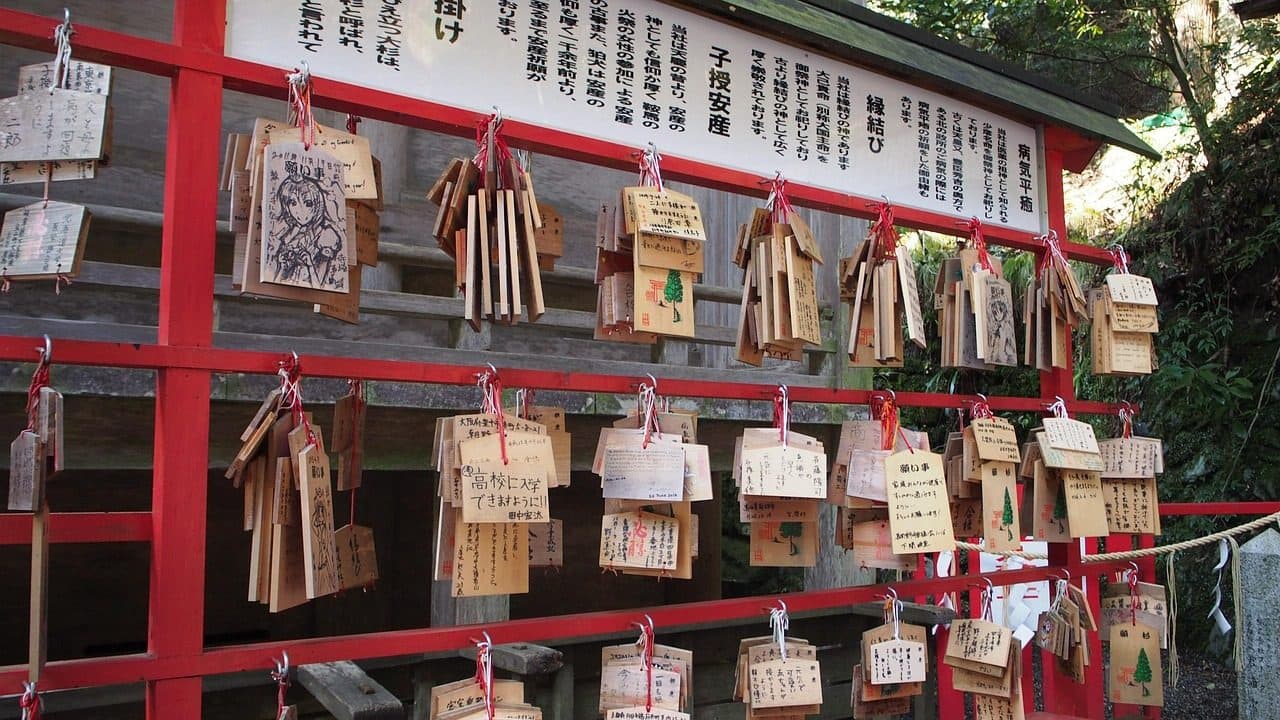
Ema are the wooden plaques you see in the photo above: you write a wish on the back and hang it at the shrine. They make a nice keepsake activity and are often less crowded than the charm counter.
Food stalls and what to eat
At the large sites, rows of yatai food stalls line the approaches during the first days of January — typical items include yakisoba, takoyaki, grilled squid, karaage, baby castella cakes, choco-banana and amazake (a sweet, warm rice drink, often non-alcoholic). Some shrines hand out or sell warm amazake or sake near the halls. Stall presence and rules differ by site: Meiji Jingu's etiquette page, for example, says eating, drinking and smoking are allowed only in designated areas. Don't eat while walking in the prayer queue, and carry your rubbish until you find the stall's bin.
What is closed January 1–3
New Year is Japan's biggest holiday, so plan your meals and sightseeing around it. In general terms:
- Many independent restaurants and small shops close from around December 29–31 until January 3 or 4. Family-run places are the most likely to be shut.
- Convenience stores, most chain restaurants, fast food and many hotel restaurants stay open. Supermarkets usually close briefly on January 1 or open with shorter hours.
- Department stores typically close on January 1 and reopen on January 2 with fukubukuro (lucky bag) sales — expect queues.
- Museums and some attractions close for several days around New Year; check each one. For example, the Hozugawa river boats are closed December 29 to January 4 (see our Hozugawa guide).
- Banks are closed December 31 to January 3, though many convenience-store ATMs keep working.
- Trains run on a holiday timetable, which means fewer trains in the morning than on a weekday.
If you want a fuller picture of winter planning (illuminations, snow trips, what sells out), see our winter guide.
What to wear and bring
- Warm layers, hat and gloves — midnight queues are outdoors, on gravel, often for an hour or more.
- Comfortable shoes; stairs and uneven ground are common.
- Coins and small notes for offerings, omikuji and charms.
- No suitcase — Meiji Jingu's official Q&A says there is nowhere to store luggage in the grounds, and the same applies in practice elsewhere.
- A charged phone and your hotel's address written down in Japanese for a taxi.
Wearing kimono for hatsumode is a real local tradition, especially on January 1–3, and many rental shops in Kyoto operate over New Year. Just plan for the cold (layers underneath, a shawl), stairs and long toilet queues, and book early — New Year dates fill up.
Can tourists do hatsumode?
Yes. Anyone can visit, make a small offering and pray, as long as you follow the queue, posted rules and staff instructions. You do not need to be religious or know the ritual perfectly.
What is the best day to avoid hatsumode crowds?
At the most famous sites, the afternoon of January 3 or any day from January 4 onward is much calmer than January 1–2. Early morning around opening time is the quietest window on any day. A small neighborhood shrine is calm even on January 1.
Do trains run all night on New Year's Eve 2026 in Tokyo?
The 2026–27 plan had not been announced as of October 2026. Last year (Dec 31, 2025 to Jan 1, 2026) JR East ran all-night service on six Tokyo-area lines including the Yamanote Line, while Tokyo Metro did not run all night. Check JR East and each railway's notice in December.
Is Meiji Jingu open at midnight on New Year's Eve?
Its regular hours follow sunrise and sunset, but New Year's Eve and early January run on a special schedule announced by the shrine closer to the date. Check Meiji Jingu's official site in late December.
How much money should I offer?
There is no set amount. Any small coin is fine; many people use a 5-yen coin because 'go-en' sounds like the word for a good connection. Bring coins and small notes, as charm and fortune counters often do not take cards.
What do I do with my old omamori charm?
Return it to the designated collection box or area at a shrine or temple, usually set up prominently at New Year. Ideally return it where it came from, and generally shrine charms to shrines and temple charms to temples.
Will restaurants be open on January 1?
Many independent restaurants close from late December to around January 3, but convenience stores, chain restaurants and many hotel restaurants stay open. Plan meals near busy stations or your hotel.