This article contains affiliate links. If you book through them we may earn a small commission at no extra cost to you — it helps keep Authentic Japan free.
This guide is for travelers routing through the Japanese Alps between Takayama and Kanazawa (or Toyama) who are trying to decide how much time to give Shirakawa-go, the UNESCO-listed village of steep thatched gassho-zukuri farmhouses. The short answer: make it a day trip if it is a scenic stop on a packed itinerary — the highway bus makes that easy and three to five hours on the ground covers the essentials. Stay overnight if the village itself is the reason you are in the region: you get the lanes in the evening and early morning, after and before the day crowds, and the experience of sleeping in a family-run farmhouse inn.
Winter changes the maths. The famous light-up runs on four evenings in January 2027 and is reservation-only — you cannot just turn up — and snow can delay buses by two hours or more. Fares, bus rules, museum hours and light-up details below were checked on the official sites of Nohi Bus, the Shirakawa-go Tourist Association and the Gassho-zukuri Minkaen open-air museum on 13 October 2026.
Day trip vs overnight at a glance
| Day trip | Overnight in the village | |
|---|---|---|
| Time on the ground | Usually 3–5 hours between buses | Afternoon, evening and the next morning |
| What you see | Viewpoint, main lanes, open-air museum — at the busiest time of day | The same, plus the village in evening and early-morning quiet |
| Booking effort | Low: reserve the bus if your service is marked as reserved | High: few rooms, small inns, often booked well ahead |
| Luggage | Easy if big bags stay in Takayama/Kanazawa or are forwarded | Travel with a small bag; lanes can be snowy and uneven |
| Food | Lunch in the village; cafés close in late afternoon | Dinner and breakfast usually at your inn; few evening options otherwise |
| Winter risk | A delayed bus can wreck an onward connection | Same risk, but you are not racing a same-day return |
| Best for | Packed itineraries, families with big luggage, first look | Photographers, slow travelers, anyone curious about rural life |
Getting there: the highway bus is the only public option
Shirakawa-go has no train station. Public access is by highway bus on the Takayama–Shirakawa-go–Kanazawa line, plus branches to Toyama and Takaoka. Nohi Bus runs the Takayama side and Hokuriku Railroad (Hokutetsu) the Kanazawa side; Kaetsuno Bus and Toyama Chiho Railway cover Takaoka and Toyama. The Shirakawa-go bus stop is next to the Ogimachi village, so you walk straight in.
| From | One-way fare (adult) | Notes |
|---|---|---|
| Takayama (Nohi Bus Center) | ¥2,800 | About 50 minutes; 16 round trips a day on this section |
| Kanazawa Station | ¥2,800 | Check journey time on the timetable for your service |
| Toyama Station | ¥2,400 | Fewer services than Takayama/Kanazawa |
| Takaoka / Shin-Takaoka | ¥2,200 | Fewer services than Takayama/Kanazawa |
Fares are from Nohi Bus's official Shirakawa-go route page as of October 2026. On the timetable, services marked "R" require a reservation; the others are non-reserved and you board in order. Reserved services can be booked online through Japan Bus Online, or by phone with the operator for each line (Nohi Bus for Takayama, Hokuriku Railroad for Kanazawa). If your service is reservation-required, book both legs as soon as your dates are fixed — in autumn foliage season and in January, the popular morning-in, afternoon-out times fill first.
- Good routes: Takayama → Shirakawa-go → Kanazawa, or the reverse. You see the village on the way rather than going out and back.
- Also fine: Toyama or Takaoka → Shirakawa-go → Takayama, if you are coming off the Hokuriku Shinkansen.
- Avoid: a same-day round trip from Tokyo, Kyoto or Osaka. The bus leg is unavoidable and you would spend most of the day in transit.
- Avoid: leaving 15–20 minutes between the Shirakawa-go bus and a train, flight or another reserved bus — especially in winter.
Some services do not run on weekends, holidays, 13–15 August or 29 December – 3 January, and some stops are skipped on those days, so always check the timetable for your actual date. If you are planning Takayama as your base, our Takayama old town guide with the Shirakawa-go combo covers the Takayama side of the day. For deciding whether a rail pass covers the train legs either side, see JR Pass vs regional passes — the Shirakawa-go bus itself is a separate fare.
The day trip, done well
A good day trip is a focused visit to Ogimachi, the main district, not a race. The village is compact: most of what you came for is within a 15-minute walk of the bus stop. What makes a day trip disappointing is arriving at midday with the tour buses, queueing for the viewpoint and rushing back.
- Arrive early. Take a morning bus so you are in the village before the late-morning peak, and plan an early-to-mid-afternoon bus out.
- Viewpoint first if the sky is clear. The Ogimachi Castle Ruins observation deck gives the classic view over the valley. Weather in the mountains changes fast, so do it while you can see.
- Walk the lanes slowly. Step aside for residents' cars, keep voices down and stay off private land — people live in these houses.
- Gassho-zukuri Minkaen — the open-air museum across the river — is worth an hour if you want to see inside the houses rather than only photograph them.
- Lunch: keep it flexible; small places fill at midday and many close in the late afternoon.
| Stop | Time to allow |
|---|---|
| Observation deck and photos | 30–45 minutes |
| Walking the Ogimachi lanes | 60–90 minutes |
| Gassho-zukuri Minkaen | 60–90 minutes |
| Lunch or coffee | 30–60 minutes |
| Total | About 3 hours minimum; 4–5 hours is more comfortable |
Gassho-zukuri Minkaen (official site, as of October 2026): adults ¥800, children ¥400 (elementary to high school), preschoolers free. Open 8:40–17:00 from March to November and 9:00–16:00 from December to February, last entry 20 minutes before closing. From December to March it closes on Thursdays (the day before, if Thursday is a public holiday), and it can close temporarily in strong wind or heavy snow.
If you would rather not juggle bus reservations, a guided tour is the low-effort version of the day trip: it handles the transport and timing, at the cost of a fixed schedule.
Staying overnight in a gassho-zukuri farmhouse
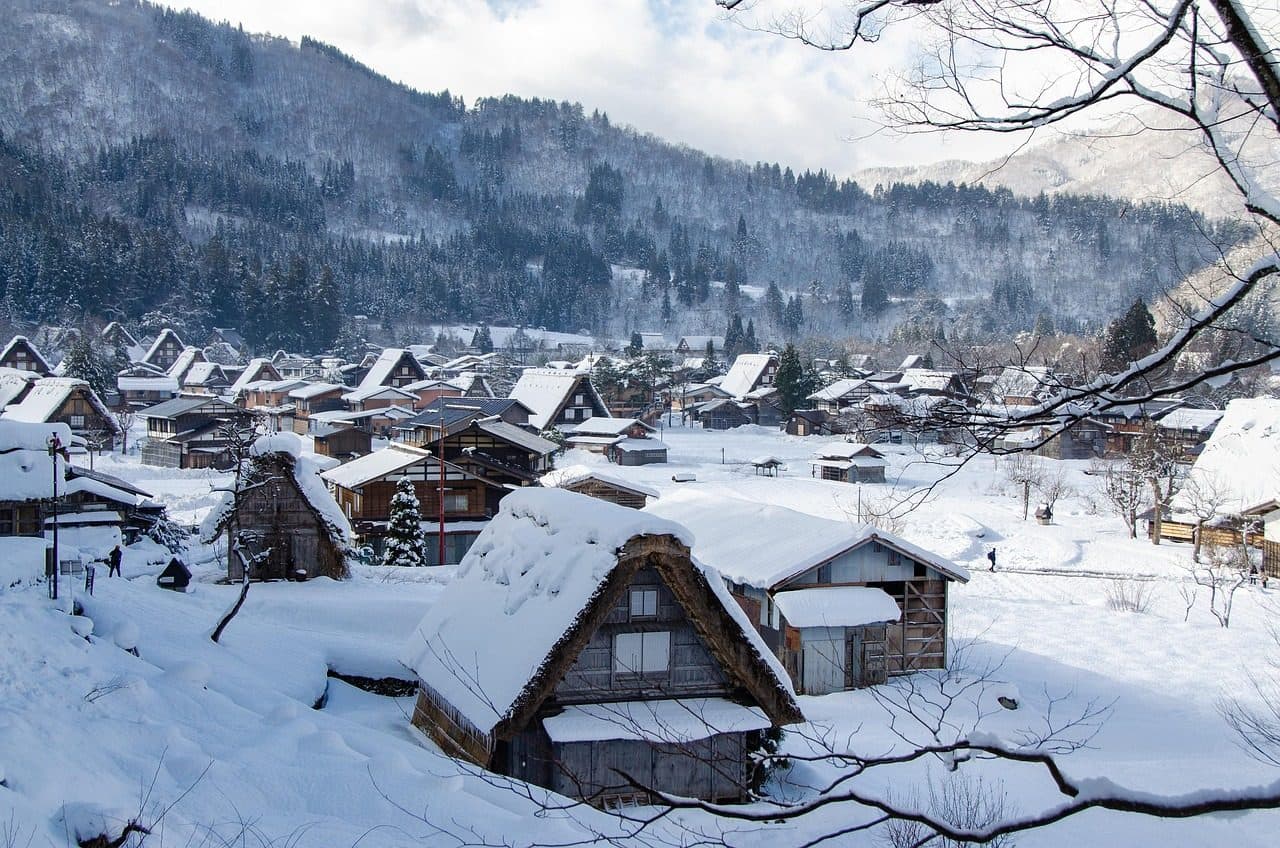
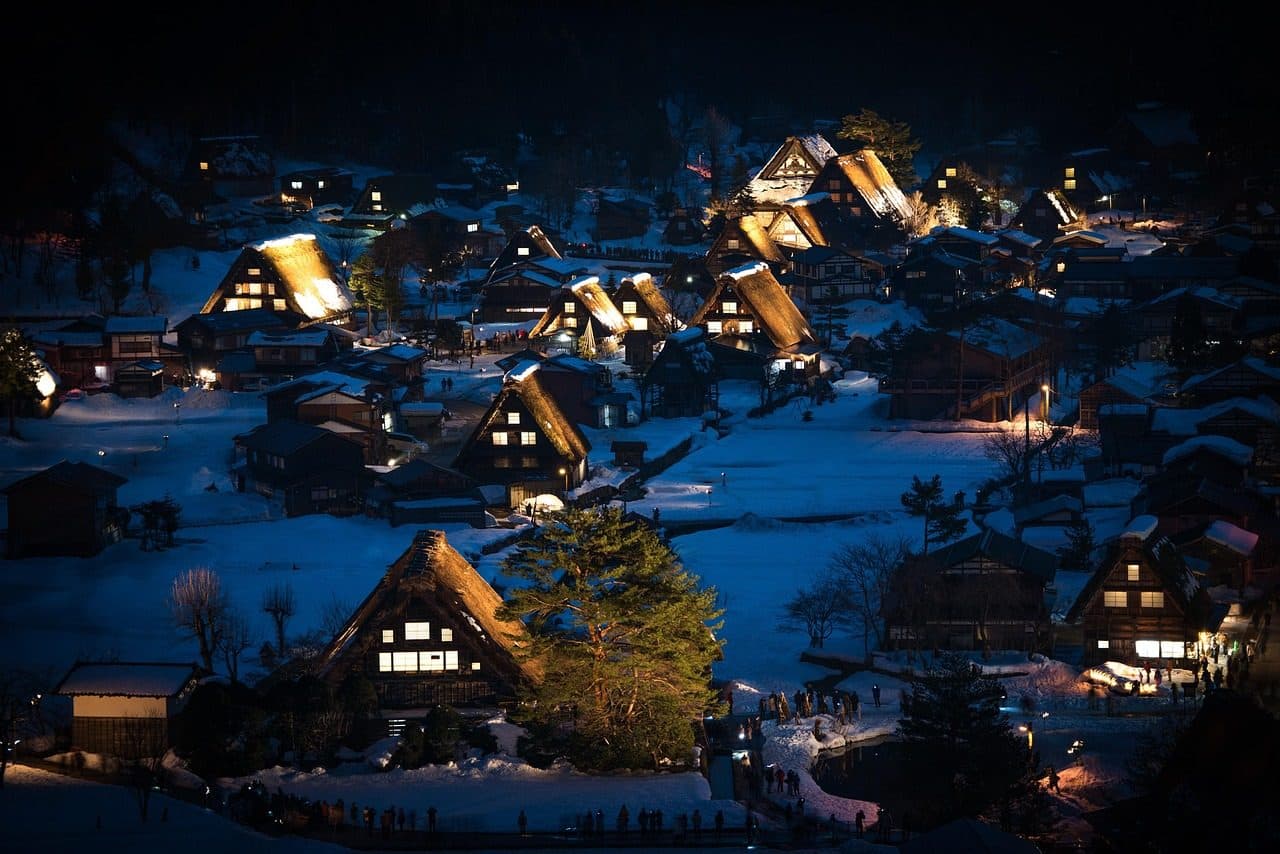
Overnighting is not about nightlife — there is very little. It is about time. Once the last day buses leave in the late afternoon, the village quietens down, and the next morning you can walk the lanes before the first big wave arrives. In winter, with snow on the roofs and lights in the windows, that is the image most people came for.
Most of the in-village lodgings are minshuku — family-run guesthouses, several of them in actual gassho-zukuri houses. Expect something closer to a homestay than a hotel or a luxury ryokan:
- Rooms: tatami rooms with futons laid out on the floor; walls and sliding doors are thin, so sound carries.
- Bathrooms: often shared toilets and a shared bath; check before booking if you need private facilities.
- Meals: dinner and breakfast are usually included and served at set times, often early. Mountain-village food — river fish, mountain vegetables, Hida beef at some inns — rather than a menu to choose from.
- Evenings: quiet. Inns may set a time by which you should be back or by which the bath closes; ask at check-in and respect it.
- Cancellation: small inns can have stricter cancellation rules than chain hotels. Read them before you pay.
- Getting a room: there are few rooms and they go early, especially on weekends, in autumn foliage season and in winter. Treat it as something to book as soon as your route is fixed.
The Shirakawa-go Tourist Association's English site has a list of accommodations and a room-availability calendar, which is the easiest place to start. Confirm meal inclusion, check-in time, bath and toilet arrangements, heating and the cancellation policy with the inn or booking channel directly. If this is your first time sharing a bath in Japan, our onsen etiquette guide covers the basics that also apply to an inn bath.
Winter light-up 2027: how it actually works
The 41st Shirakawa-go Light-Up takes place on four evenings: 11 January (Monday, public holiday), 17 January, 24 January and 31 January 2027, from 17:30 to 19:30, according to the Shirakawa-go Tourist Association. Advance reservation is mandatory: visitors who arrive on the day without one will not be allowed in, and no tickets are sold on the day. Entry tickets are worn on a neck holder, colour-coded by date and checked at a gate. The event can be cancelled if a severe cold wave causes major transport disruption.
There are five ways in. Only some of them include a ticket for the observation deck — the classic view of the lit village from above — which is not sold separately, has limited capacity, assigns you a viewing time, and bans tripods.
| Way to attend | Observation deck ticket? | How and when (2026–27) |
|---|---|---|
| Overnight stay in Shirakawa Village | Included | Lottery. Applications by email 1 Oct (13:00 JST) – 31 Oct 2026; winners notified 10 Nov 2026. One application per person |
| Reserved parking (own car, up to 10 people) | No | First come. Round 1 from 10 Sep 2026 (sold out); round 2 from 1 Dec 2026, ¥7,000 (1–5 people) / ¥10,000 (6–10) |
| Reserved parking + taxi | No | Reserve parking first, then a taxi; no taxi waiting area |
| Highway bus tour (Nohi Bus, Hokutetsu Bus, Kaetsuno Bus, Toyama Chiho Railway, Iruka Kotsu) | Some tours | Sales from 14:00 JST: 13 Oct (for 11 Jan), 19 Oct (17 Jan), 26 Oct (24 Jan), 2 Nov 2026 (31 Jan) |
| Travel agency bus tour | No | Tour list posted on the Tourist Association site from 2 Dec 2026, 13:00; book with the agency |
For most overseas visitors without a car, realistic options are the lodging lottery (if you can still apply before 31 October) or a highway bus tour from Takayama, Kanazawa or Toyama. Bus tour sales open on staggered dates and the best ones — those that include an observation deck ticket — are the hardest to get, so be ready at 14:00 Japan time on the sale date for your evening. The lodging lottery rules are strict: apply once only (multiple applications invalidate all of them), apply in the name of the person staying, and note that only winners are contacted. If any winners decline, extra rooms are released first-come from 26 November 2026.
Also note that regular buses do not run after the event ends, and on event days daytime visitors arriving by regular bus must arrive by 15:20, when an entrance gate goes up. In other words, you cannot "day trip and stay for the lights" on a normal bus ticket. If you just want snowy Shirakawa-go without the light-up logistics, pick a different January or February day — the village is just as snowy, much easier to reach, and you can still see the houses lit from inside if you stay overnight. For other winter ideas, see things to do in Japan in winter.
Snow season practicalities
- Footwear: waterproof, insulated boots with real grip. The lanes are packed snow and ice from roughly December into March; the Tourist Association recommends anti-slip footwear or traction devices for the light-up, and the same applies on any winter day.
- Clothing: on light-up evenings the organisers warn of temperatures between −10°C and 0°C. Hat, gloves and layers you can add while standing still.
- Bus delays: Nohi Bus warns that delays of two hours or more can occur because of traffic, heavy snow or expressway closures. Do not plan a same-day flight or a non-refundable connection straight after Shirakawa-go in winter.
- Cancellations: if an expressway closes, services can be suspended. Check the operator's site on the morning of travel and keep a spare night or a flexible onward ticket in your plan.
- Light: bring a small torch (flashlight) for evening walks back to your inn — paths are dark outside the main lanes.
- Drones: prohibited throughout the village.
Which one should you choose?
| Your situation | Better choice | Why |
|---|---|---|
| First trip to Japan, 10 packed days | Day trip | Fits between Takayama and Kanazawa without losing a night |
| Photographer chasing soft light or snow | Overnight | Evening and early-morning light without crowds |
| Family with large suitcases | Day trip (or forward bags) | Easier logistics; inns have little space |
| Slow traveler doing Takayama + Kanazawa | Overnight | Splits the journey naturally |
| Want the January light-up | Lottery stay or bus tour | No same-day entry; plan around the reservation rules |
| Need private bathroom, late dinner, flexible cancellation | Day trip | Village inns are simple and run on fixed times |
A clean day-trip plan: morning bus from Takayama, viewpoint, lanes, Minkaen, lunch, mid-afternoon bus on to Kanazawa (or back). A clean overnight plan: forward your big bag, arrive early afternoon, walk the village as the buses leave, dinner at the inn, early-morning walk, then a late-morning bus onward. If you are on mobile data the whole way, a working eSIM makes it much easier to check bus delays on the road — see best eSIM for Japan.
Is Shirakawa-go better as a day trip or an overnight stay?
A day trip is enough if you want the viewpoint, the main lanes and the open-air museum — allow 3 to 5 hours. Stay overnight if you want the village in the quiet evening and early morning and the experience of a family-run farmhouse inn.
How much is the bus from Takayama or Kanazawa to Shirakawa-go?
As of October 2026, Nohi Bus lists ¥2,800 one way from Takayama or Kanazawa, ¥2,400 from Toyama and ¥2,200 from Takaoka. Takayama to Shirakawa-go takes about 50 minutes.
Do I need to reserve the Shirakawa-go bus?
Some services, marked R on the timetable, require a reservation; others are non-reserved. Reserved services can be booked through Japan Bus Online or by phone with the operator.
When is the Shirakawa-go light-up in 2027?
On 11, 17, 24 and 31 January 2027, from 17:30 to 19:30. Advance reservation is mandatory and no tickets are sold on the day.
Can I visit the light-up on a normal day trip?
No. Entry needs an advance reservation through a lottery stay, reserved parking or a bus tour, regular-bus visitors must arrive by 15:20, and no regular buses run after the event.
Can I go to Shirakawa-go by train?
No. There is no station. The village is reached by highway bus from Takayama, Kanazawa, Toyama or Takaoka, or by car or tour.
What should I wear in Shirakawa-go in winter?
Waterproof insulated boots with good grip or traction devices, a warm coat, hat and gloves. Evening temperatures can fall to around −10°C, and the lanes are packed snow and ice.