This article contains affiliate links. If you book through them we may earn a small commission at no extra cost to you — it helps keep Authentic Japan free.
This guide is for first-time visitors in Tokyo deciding whether Nikko works as a day trip, which train to take, and whether a Tobu NIKKO PASS beats normal tickets. The short answer: yes, one day is enough, but only if you choose one of two plans before you leave — the World Heritage shrine area done properly, or the shrines plus Kegon Falls and Lake Chuzenji at a faster pace. Trying to add Yumoto Onsen, Kinugawa or long hikes turns the day into a bus timetable exercise.
Fares, opening hours and pass conditions below were checked on official sites (Tobu Railway, Nikko Toshogu, the Kegon Falls elevator operator and the Nikko Tourism Association) on 13 October 2026. Where we could not confirm a number on an official page — for example the current limited express surcharge or individual bus fares — we say so and tell you where to check, rather than print a figure that might be out of date.
Day trip or overnight? The quick decision
Nikko is not one place. The shrine area around Toshogu sits next to the town and the stations. Kegon Falls and Lake Chuzenji are higher up in Okunikko, reached by bus up the Irohazaka hairpin road — the official Nikko guide puts the ride at about 40 minutes from the stations to Chuzenji Onsen, in normal traffic. Yumoto Onsen and the Senjogahara marshland are further still. Distance is not the issue on paper; the bus queues and the road are.
| Your situation | Best choice | Why |
|---|---|---|
| First visit, mainly interested in shrines and history | Day trip, shrine area only | Toshogu, Rinnoji, Futarasan and Shinkyo Bridge fill a relaxed 5–6 hours without any mountain bus |
| You want shrines and Kegon Falls, weekday | Day trip, early start | Workable if you are on a train that reaches Nikko by about 9:00–9:30 and keep Toshogu to around 90 minutes |
| You want shrines and Kegon Falls on an autumn weekend | Overnight (or skip the falls) | Irohazaka traffic in peak foliage can stretch the bus ride well beyond the timetable |
| You also want Yumoto Onsen, Senjogahara or a hike | Overnight | These are full half-days on their own, further up the same road |
| You have a JR Pass and want to use it | Day trip via Utsunomiya | The JR route is covered by the pass; the Tobu trains from Asakusa are not |
| You want Nikko and Kinugawa Onsen | Overnight | Kinugawa is a separate resort area on a different branch line |
Getting there: Tobu from Asakusa vs the JR route
There are three realistic ways to reach Nikko from central Tokyo. The Nikko tourism site describes limited express services from both Asakusa and Shinjuku taking about two hours. Which is best depends mostly on where you are staying and whether you hold a Japan Rail Pass.
| Route | Train | Time (approx.) | Good for | Watch out for |
|---|---|---|---|---|
| Asakusa → Tobu-Nikko (Tobu) | Limited Express SPACIA X or Kegon/Revaty-type limited expresses; slower rapid/local trains too | About 2 hours by limited express; about 1 hour more by local trains | Most travelers, especially with a NIKKO PASS | Limited express surcharge is extra, even with a NIKKO PASS; all-reserved trains sell out on autumn weekends |
| Shinjuku → Tobu-Nikko (JR–Tobu through train) | JR–Tobu through limited express | About 2 hours | Travelers staying in west Tokyo | Few departures a day; not fully covered by the JR Pass because it runs on Tobu tracks |
| Tokyo/Ueno → Utsunomiya → JR Nikko (JR) | Tohoku Shinkansen, then JR Nikko Line | About 2 hours including the change | JR Pass holders | One transfer at Utsunomiya; without a JR Pass it usually costs more than Tobu |
SPACIA X is Tobu's flagship limited express, with standard and premium seats plus box seats, compartments and a lounge-style cockpit car at extra charge. Every seat is reserved, so you need a limited express ticket on top of the base fare. Tobu's slightly older limited expresses on the same line are a cheaper way to get the same journey time. We could not confirm the October 2026 surcharges on an official Tobu page while researching, so check the fare on Tobu's own booking site (or at the Asakusa ticket office) — and book a few days ahead for any weekend from mid-October to mid-November.
If you hold a Japan Rail Pass, the JR route via Utsunomiya costs you nothing extra and is easy: the JR Nikko Line terminates at JR Nikko Station, a short walk from Tobu-Nikko Station. If you do not hold a JR Pass, the Tobu route from Asakusa is normally the simpler and cheaper choice. Our JR Pass vs regional passes guide explains when the national pass is worth buying at all.
NIKKO PASS vs single tickets: which wins for one day?
Tobu sells two NIKKO PASS products for foreign visitors (Japanese nationals travelling with them can also buy them; a passport is checked). Both include one round trip between Asakusa and Shimo-Imaichi plus unlimited Tobu trains between Shimo-Imaichi, Tobu-Nikko and Shin-Fujiwara (Kinugawa). Neither includes the limited express surcharge, shrine and temple admissions, or the SL Taiju reserved seat.
| NIKKO PASS world heritage area | NIKKO PASS ALL AREA | |
|---|---|---|
| Price (adult / child) | ¥3,000 / ¥1,500 | ¥8,000 / ¥4,000 |
| Validity | 2 days | 4 days |
| Rail | Asakusa–Shimo-Imaichi round trip + Tobu Nikko/Kinugawa area | Same |
| Buses | Tobu buses within the World Heritage (shrine) area | All Tobu Bus lines in Nikko, incl. Chuzenji Onsen and Yumoto; Nikko–Kinugawa bus on Sat/holidays |
| Extras | — | Lake Chuzenji cruise and Odashirogahara hybrid bus (mid-April to 30 November), one day-use onsen visit, winter ski-lift ride |
| Limited express surcharge | Not included | Not included |
| Best for | Shrine-only day trip | Overnight trips, or a day with Kegon Falls plus the lake cruise |
For a shrine-only day, the world heritage area pass is the obvious candidate: the round trip from Asakusa plus the shrine-area buses for ¥3,000. Compare it against two single base-fare tickets Asakusa–Tobu-Nikko on Tobu's fare search before you buy — the pass usually comes out ahead once you add a couple of bus rides, but the margin is the thing to check, not assume.
For a shrine plus Kegon Falls day, the maths is closer. The ALL AREA pass at ¥8,000 covers the long bus ride up to Chuzenji Onsen, but you only use one day of its four. Tobu Bus also sells its own bus-only free passes for the Chuzenji Onsen route at the stations; pairing the cheaper world heritage area pass with a bus pass can work out lower than ALL AREA for a single day. Bus pass prices were not shown on an official page we could access, so check them at the Tobu-Nikko Station tourist center on arrival. ALL AREA really pays off when you stay a night and also use the lake cruise.
A guided bus tour is the honest alternative if you want shrines, Kegon Falls and Lake Chuzenji in one day without managing trains and buses yourself. You lose flexibility on how long you stay at each stop, but you are not standing in the Chuzenji-bound bus queue at Tobu-Nikko Station.
Nikko Toshogu: hours, tickets and how long to spend
Toshogu, the mausoleum shrine of Tokugawa Ieyasu, is the reason most people come: lacquered gates, gold leaf, and carvings such as the three monkeys and the sleeping cat. Official hours are 9:00–17:00 from 1 April to 31 October and 9:00–16:00 from 1 November to 31 March, with admission closing 30 minutes earlier. That November change matters in autumn: if you arrive on a November afternoon, the last entry is 15:30.
| Toshogu ticket (individual) | Adult / high school | Elementary / junior high |
|---|---|---|
| Toshogu only | ¥1,600 | ¥550 |
| Toshogu + Treasure House set | ¥2,400 | ¥870 |
| Treasure House only | ¥1,000 | ¥400 |
| Art Museum only | ¥800 | ¥400 |
Allow about 90 minutes for Toshogu if you want to see the main gates and climb to the inner shrine; two hours if you read and photograph. Rinnoji and Futarasan Shrine sit right next to it and charge separately, and the red Shinkyo Bridge is at the bottom of the approach. Bring some cash for admissions and small food stalls — card acceptance varies between ticket offices, and the shrine office (0288-54-0560) is the place to ask if you need to be sure.
Kegon Falls, Lake Chuzenji and the Irohazaka road
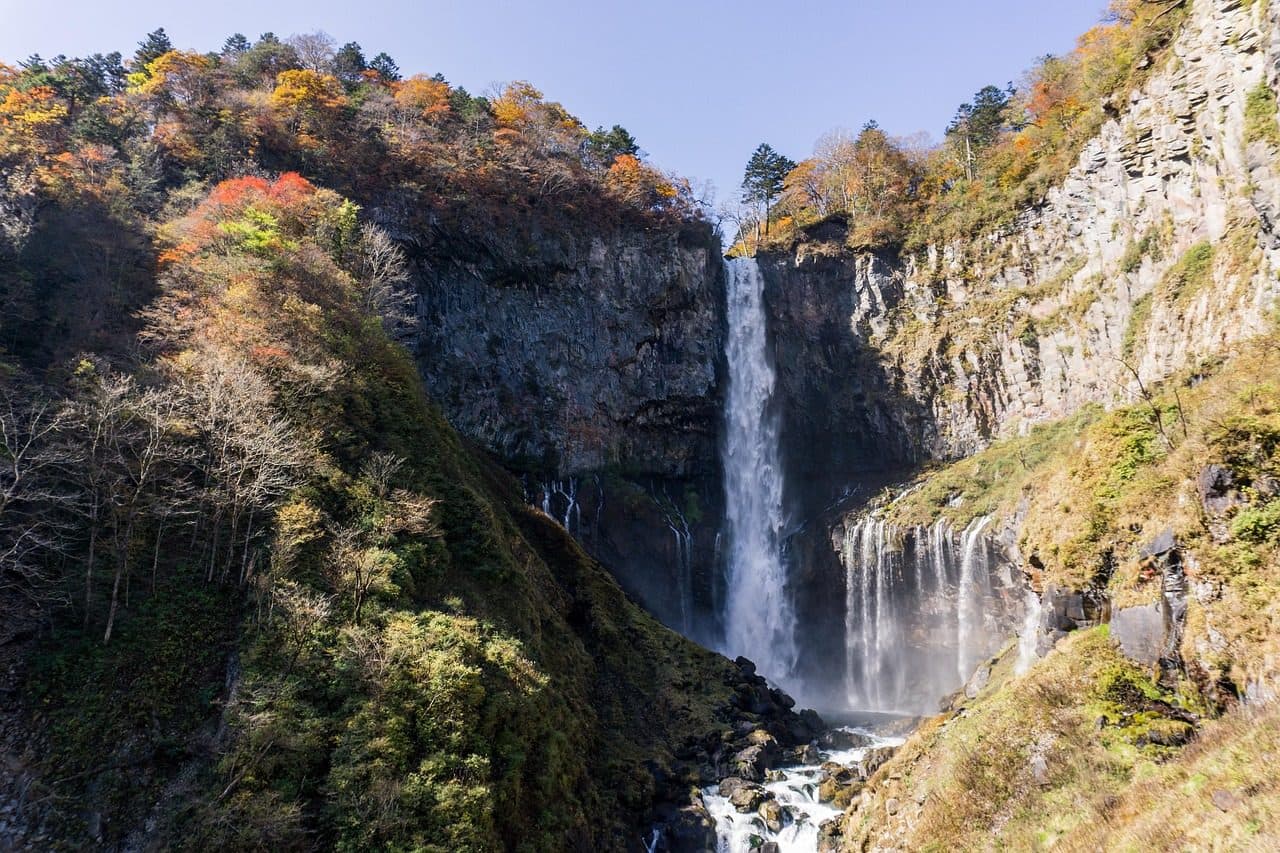
Kegon Falls drops 97 m from the outlet of Lake Chuzenji. You can see it free from the top viewpoint, but the classic view is from the platform near the base, reached by an elevator that descends about 100 m. As of October 2026 the elevator costs ¥600 return for adults and ¥400 for elementary school children (preschoolers free), runs 8:00–17:00 from March to November, and does not take reservations. Lake Chuzenji, at 1,269 m, is a few minutes' walk from the Chuzenji Onsen bus stop.
The catch is the road up. Irohazaka is a one-way pair of hairpin roads, and the Nikko Tourism Association warns that the area is very crowded in foliage season. On peak weekends the queue of cars heading up can add a lot of time to the bus ride, and the same traffic comes back down in the afternoon. Note also that the Akechidaira Ropeway, the viewpoint above Irohazaka, is suspended from 16 January 2026 to 31 August 2027 for construction, according to Tobu — do not plan around it this autumn.
Autumn timing: leaves turn from the top down
Nikko's autumn colors move downhill over about six weeks, because Okunikko is far higher than the town. The Nikko Tourism Association's foliage page gives these expected peaks for 2026, with status updates as of 11–13 October:
| Area | Expected peak (official forecast) | Status on 11–13 Oct 2026 |
|---|---|---|
| Senjogahara and Odashirogahara (Okunikko, highest) | Mid to late October | Oak trees at peak; grassland colors fading |
| Ryuzu Falls, Yunoko and Yudaki | Early to mid October | Peak starting at Ryuzu; Yunoko beginning to turn |
| Lake Chuzenji and Kegon Falls | Mid October to early November | Not yet turned at last update |
| Irohazaka | Mid October to early November | Not yet turned at last update |
| Kirifuri Falls | Late October to early November | Not yet |
| World Heritage shrines and temples (town) | Early to mid November | Not yet |
What this means for a day trip: late October is the window for Kegon Falls and Lake Chuzenji, but the shrine area will still be mostly green. Early to mid November puts color around Toshogu and Shinkyo Bridge, while the lake is likely past its best. You rarely get both at peak on the same day, so pick the part you care about. The tourism association also lists two evening events for 2026: Light Up NIKKO on 6–8 November and the Kegon Falls light-up on 14–23 November — both are easier with an overnight stay. For other regions, see our Japan autumn leaves forecast by region.
Two one-day itineraries that actually work
Plan A: the shrine area, done properly
- Around 8:00: limited express from Asakusa (or JR via Utsunomiya).
- Around 10:00: arrive Tobu-Nikko or JR Nikko; bus or 30-minute walk up to Shinkyo Bridge.
- 10:15–12:30: Toshogu, then Futarasan Shrine.
- 12:30–13:30: lunch on the main street — yuba (tofu skin) is the local specialty.
- 13:30–15:00: Rinnoji, or the quieter Kanmangafuchi Abyss path with its row of stone Jizo statues.
- 15:30–16:30: walk or bus back down; limited express to Tokyo, back around early evening.
This is the plan for November, for slow walkers, for families and for anyone who has not booked a limited express in advance. It has slack built in, so a full train or a long lunch does not break it.
Plan B: shrines plus Kegon Falls (weekday, early start)
- Before 7:30: leave Asakusa on an early limited express (book the seat in advance).
- Around 9:30: arrive and go straight to Toshogu; keep it to about 90 minutes.
- 11:30: bus back towards the station or on towards Chuzenji Onsen — check the next departure before lunch.
- 12:00–13:00: bus up Irohazaka to Chuzenji Onsen (about 40 minutes in normal traffic); eat near the lake.
- 13:00–14:30: Kegon Falls elevator (last ride before 17:00) and a short walk by Lake Chuzenji.
- 15:00 at the latest: bus back down, allowing extra time in foliage season; evening train to Tokyo.
Do this in the reverse order on a busy autumn day if you can: go up to Kegon Falls first thing, when traffic on Irohazaka is lighter, and do the shrines in the afternoon — remembering Toshogu's last entry is 16:30 in October and 15:30 in November. Put your return train's departure time in your phone before you get on the bus up the mountain.
What to skip on a one-day trip
- Yumoto Onsen and Senjogahara — beautiful, but another stage further up the same road; save them for an overnight.
- Kinugawa Onsen and the theme parks — a separate area; combining them with Toshogu and Kegon Falls in a day does not work.
- Akechidaira Ropeway — suspended until at least 31 August 2027.
- A long sit-down lunch on Plan B — it is usually what costs you the Kegon Falls bus.
- Weekend driving in late October — the Irohazaka queues are the main reason day trips go wrong.
Still not sure Nikko is the right day trip? Our Hakone vs Nikko comparison weighs the two directly, and the best day trips from Tokyo guide covers Kamakura, Kawagoe and others that need less planning. For getting around Tokyo before and after, a loaded Suica card also works on local trains in the Nikko area.
Is one day enough for Nikko?
Yes, for the World Heritage shrine area (Toshogu, Rinnoji, Futarasan and Shinkyo Bridge), or for the shrines plus Kegon Falls if you start early on a weekday. If you also want Yumoto Onsen, Senjogahara or a relaxed autumn weekend, stay one night.
How long does it take to get from Tokyo to Nikko?
About two hours by limited express from Asakusa (Tobu) or Shinjuku (JR–Tobu through train), or about two hours via the Tohoku Shinkansen to Utsunomiya and the JR Nikko Line. Local trains from Asakusa take roughly an hour longer.
Is the NIKKO PASS worth it for a day trip?
The NIKKO PASS world heritage area (¥3,000 adult, 2 days) is usually good value for a shrine-only day because it includes the round trip from Asakusa and shrine-area buses. The ALL AREA pass (¥8,000, 4 days) makes most sense for overnight trips. Neither includes limited express surcharges or shrine admissions.
Does the JR Pass cover the trip to Nikko?
Yes on the JR route: Tohoku Shinkansen to Utsunomiya, then the JR Nikko Line to JR Nikko Station. The Tobu trains from Asakusa, including SPACIA X, are not covered.
When are the autumn leaves best in Nikko in 2026?
The Nikko Tourism Association expects mid-October to early November around Lake Chuzenji, Kegon Falls and Irohazaka, and early to mid-November around the World Heritage shrines in town. The higher Senjogahara area peaks earlier, in mid to late October.
How much is the Kegon Falls elevator?
As of October 2026, ¥600 return for adults and ¥400 for elementary school children; preschoolers are free. It runs 8:00–17:00 from March to November and does not take reservations.
What are Nikko Toshogu's opening hours?
9:00–17:00 from April to October and 9:00–16:00 from November to March, with last entry 30 minutes before closing. Adult admission is ¥1,600.


