This article contains affiliate links. If you book through them we may earn a small commission at no extra cost to you — it helps keep Authentic Japan free.
Bowing is one of Japan's most visible etiquette habits, but visitors often make it harder than it needs to be. You don't need to perform formal business etiquette on a vacation — you do need to understand that a bow can mean greeting, thanks, apology, respect, or acknowledgment, depending on the situation.
JNTO's official traveler guidance says visitors are more likely to be bowed at than expected to bow, but that adding a bow to "arigato" is a respectful gesture (source: japan.travel, verified 2026-07). That's the right baseline for most travelers: small, calm, and not theatrical. If you're also working out the everyday mechanics of getting around — trains, stations, crowds — the Japanese train etiquette guide covers the same "keep it small and observe" logic.
The traveler version: keep it small
For everyday travel situations, use a light nod or small bow from the shoulders and upper body. Good moments include:
- Saying thank you to hotel staff.
- Receiving help at a station counter.
- Leaving a small restaurant.
- Apologizing after bumping into someone.
- Entering or leaving a traditional space.
- Acknowledging staff at a ryokan, temple lodging, or cultural activity.
Don't worry about exact angles. Most travelers need warmth and restraint, not perfect form.
When a nod is enough
A nod is enough for quick, casual interactions: convenience store payment, ticket gates, elevator door-holding, or a quick "sumimasen" when passing through a crowd. If the other person gives a deeper bow, you can return a small bow without trying to match it.
The practical reality: staff may bow because it's part of service culture. That doesn't require you to bow repeatedly until both people are trapped in a loop.
When to bow a little more
Bow slightly more when the moment has more weight:
- Someone goes out of their way to help.
- You're entering a home, ryokan, temple lodging, or formal room.
- You're thanking a guide, teacher, host, or artisan.
- You're apologizing for causing inconvenience.
Keep your back relaxed, look down briefly, and return upright. Holding the bow for too long can feel more dramatic than polite.
Deep bows are not everyday tourist behavior
Deep bows belong to formal apologies, ceremonies, shrine worship, martial arts, tea ceremony, and business settings. As a visitor, a deep bow in a casual cafe or shop can feel excessive. The safer move is a modest bow with clear words: "arigato gozaimasu" for thanks, "sumimasen" for excuse me or apology.
Bowing at shrines
Shrine etiquette is a special case. Meiji Jingu's official English instructions explain the basic sampai sequence: put coins into the offertory box if you wish, bow twice, clap twice, and bow once again (source: meijijingu.or.jp, verified 2026-07).
The steps are:
- Approach quietly.
- Put coins into the offertory box if you choose.
- Bow twice.
- Clap twice.
- Offer a silent prayer or moment of respect.
- Bow once again.
Some shrines have local variations, so posted instructions at the shrine take priority. If you want a deeper grounding in shrine and temple visiting before you go, the Kyoto and Nara shrine and temple guide walks through what to expect at specific sites.
Meiji Jingu also states that it is free of charge and opens from sunrise to sunset, with exact times varying by month (source: meijijingu.or.jp, verified 2026-07). If you're using Tokyo cultural sightseeing to practice shrine manners, a guided Asakusa rickshaw tour past Senso-ji and the old craft streets can make the context clearer.
Bowing at temples
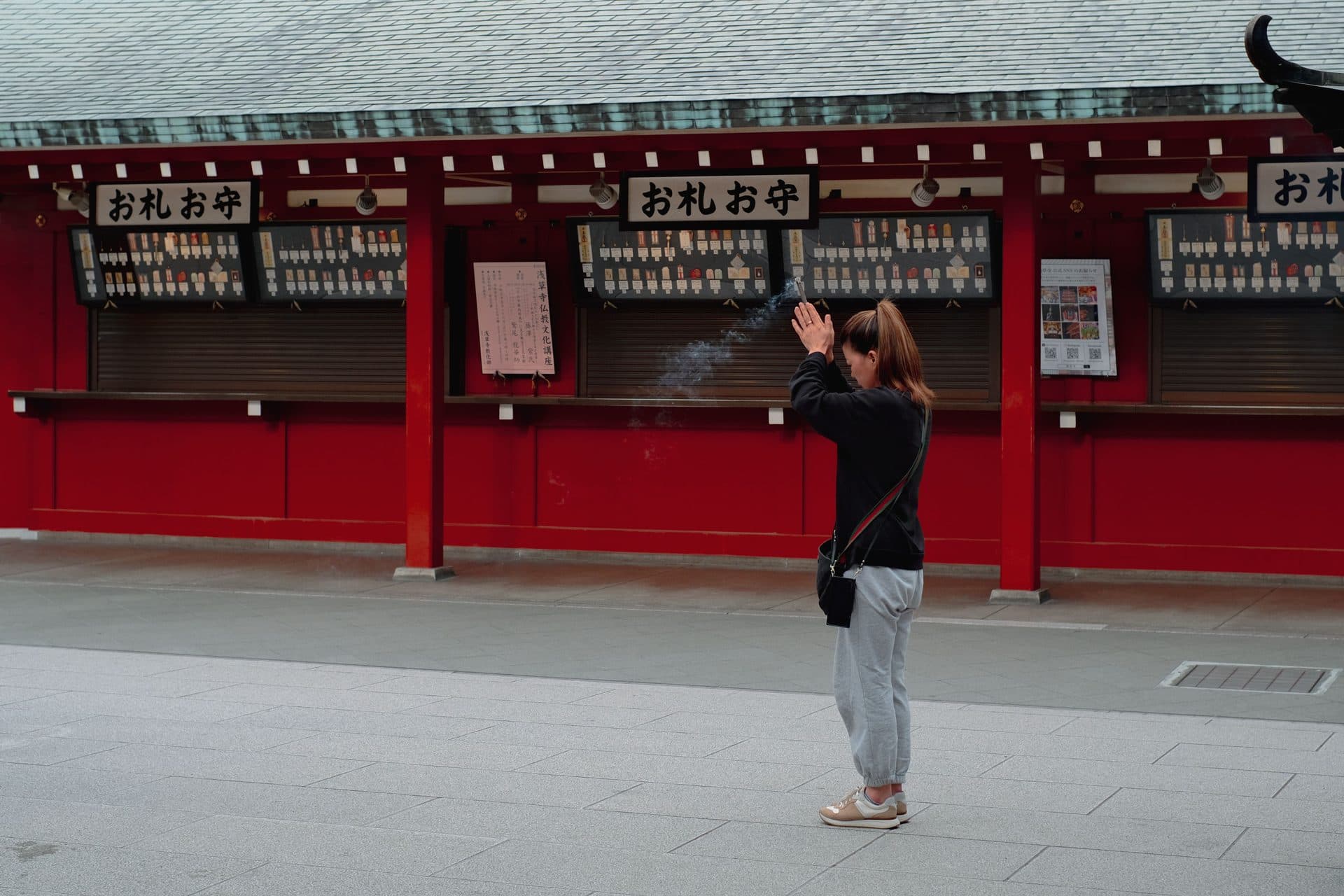
Temple behavior varies by sect and site. You may see people bow before entering a gate, bow before an altar, put hands together, offer incense, or sit quietly. Follow posted instructions and the flow of visitors. Don't clap at Buddhist temples unless a site specifically instructs it — clapping is associated with Shinto shrine worship.
Bowing in shops, restaurants, and hotels
In service settings, bowing is usually part of the staff's professional rhythm. Hotel staff may bow when greeting you, restaurant staff may bow when you leave, and shop staff may bow after a purchase. You can return a small nod or short bow, but you don't need to mirror the exact depth. In fact, trying to match every service bow can make the exchange feel awkward, because the staff member is doing a practiced workplace gesture.
The best traveler response is simple: pause, make eye contact briefly if natural, say "arigato gozaimasu," and add a small bow. If you're carrying bags, holding a tray, or standing in a narrow aisle, a nod is enough. Practical politeness matters more than a formal shape — the same principle behind not causing trouble in day-to-day interactions.
Bowing in cultural activities
Tea ceremony, martial arts, calligraphy lessons, craft workshops, and temple lodgings may use bowing more deliberately. In these settings, wait for the teacher or host to show the rhythm. You may bow at the start of the session, before handling tools, when receiving an item, and at the end to thank the instructor.
Don't rush to fill every silence with a bow. Cultural activities often have quiet moments where watching is the best etiquette. If the host places an object in front of you with both hands, receive it carefully, say thank you, and follow their body language.
Bowing and handshakes
International business meetings often include handshakes, and travel encounters sometimes do too. Avoid bowing deeply while shaking hands, because it can become physically awkward. If someone offers a handshake, shake hands naturally and add a small nod before or after.
If nobody offers a handshake, a small bow is fine. In casual tourist settings, a smile, "arigato gozaimasu," and a small nod usually work.
Common mistakes
- Over-bowing: repeated bowing can feel nervous rather than respectful. One small bow is usually enough.
- Bowing while walking into people: pause briefly or make the bow small — don't create a collision in a station, restaurant aisle, or shop doorway.
- Using a deep bow for everything: deep bows carry weight. Save them for serious apology, formal gratitude, or ritual settings.
- Treating all bows as religious: most everyday bows are social etiquette, not worship. Shrine and temple bows are a separate context.
What most guides miss
Bowing is not a tourist performance. It's a low-friction way to show that you noticed the other person. The best traveler bow is often barely more than a pause, a lowered head, and the right phrase.
That's why the same gesture can appear at a hotel desk, a shrine, a restaurant, a train platform, and a workshop, but with different meaning each time. The setting tells you how much formality is appropriate.
Useful phrases to pair with a bow
- Arigato gozaimasu: Thank you.
- Sumimasen: Excuse me / sorry / thank you for the trouble.
- Onegaishimasu: Please / I appreciate your help.
- Shitsurei shimasu: Excuse me, often when entering, leaving, or interrupting.
The words matter. A silent bow can be understood, but a short phrase makes the intention clearer.
Quick guide
- Casual thanks: small nod.
- Staff helped you: small bow plus "arigato gozaimasu."
- Minor apology: small bow plus "sumimasen."
- Shrine worship: follow the shrine's posted sequence; at Meiji Jingu, bow twice, clap twice, bow once.
- Business meeting: follow the host's lead.
- Unsure: keep it small.
Do tourists need to bow in Japan?
Tourists are not expected to master formal bowing, but a small bow with thanks is a respectful gesture in many everyday situations.
How deep should I bow in Japan?
For travelers, a light nod or small bow is enough for casual thanks. Deep bows are for formal apologies, ceremonies, or shrine worship.
Should I bow and shake hands at the same time?
Avoid doing both at once. If someone offers a handshake, return it naturally; a small nod before or after is enough.
Do I need to bow to train staff?
No formal bow is required. A small nod is enough if staff help you.
Is it rude not to bow?
In many tourist situations, no. But a small bow with thanks is appreciated and easy to learn.